Powered by Blogger.

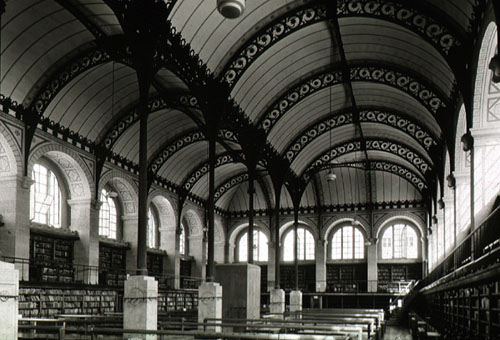
On Reading Joyce in Saint Genevieve


"It must be a movement then, an actuality of the possible as possible. Aristotle's phrase formed itself within the gabbled verses and floated out into the studious silence of the library of Saint Genevieve where he had read, sheltered from the sin of Paris, night by night. By his elbow a delicate Siamese conned a handbook of strategy. Fed and feeding brains about me: under glowlamps, impaled, with faintly beating feelers: and in my mind's darkness a sloth of the underworld, reluctant, shy of brightness, shifting her dragon scaly folds. Thought is the thought of thought. Tranquil brightness. The soul is in a manner all that is: the soul is the form of forms. Tranquility sudden, vast, candescent: form of forms."  --from Ulysses


Strange to think that in two months' time I'll be reading elsewhere.

Verjus

Once upon a time there was a Hidden Kitchen in Paris: one apartment, two Americans, and a table of eight guests. But eventually their idea outgrew the square footage of their apartment, so they opened up a restaurant with a wine bar downstairs, and they called it Verjus.

Friday was the second night they were open. I'm lucky enough to have a friend here as gastronomically inclined as I am, so I wasn't left downing an entire bottle of spunky young Beaujolais wine by myself. Besides, I'm pretty sure that leisurely is written into the protocol for a proper French dinner, as sanctified by UNESCO, so Elizabeth and I did the Frenchmen proud.

Over the course of three hours of fine wine and fine conversation, this is what we ate:

buckwheat cracker,
winter pickles, greens,
pine nut butter, ricotta
monkfish, red cabbage raviolis,
seaweed, red pepper,
seafood broth
sea scallops,
grapefruit, poppyseed,
onion ash, chipotle, chive
house-smoked salmon,
beets, quail egg,
herbs, buttermilk
duck breast, white miso labne,
cauliflower, nori crumbs,
micro basil, kimchi
pork belly,
celery, chicharron, cilantro,
heirloom carrots, ricotta
I won't say that it was a perfect meal, but it was beautifully plated. Our servers were so friendly, and I really liked how the names of everyone working on the floor and in the kitchen were printed at the bottom of the menu. I'm also pretty sure we held up the service at a few of our neighboring tables because our server was so amiably chatting with us about what she was studying in Paris and where we were all from.

chocolate ganache,
pineapple habanero sorbet,
chevre custard, graham crumbs
There were some missteps, which is entirely understandable for only their second night open, with a full slate of reservations for both seatings. Some things were only a bit off: certain flavor combinations didn't sing, or else drowned each other out. The flavors on the cracker weren't punchy enough, especially since it was the starter. The scallops just couldn't hold up to both the bitterness of grapefruit and the heat of chipotle; I'm doubtful as to whether bitter/spicy is the greatest combination in the first place.

But every subsequent dish just climbed in excellence. The little raviolis that followed were delicious, stuffed with perfectly salted cabbage. I'm a sucker for seaweed, and adding dehydrated red pepper lent it all a satisfying crunch. The salmon plate was perfectly cooked: ideal flakiness on the fish, just-barely-set yolk on the egg, perfectly roasted perfectly violet beets. And with the next two dishes, I sort of lose my capacity for speech, so I'll just let those pictures show you how meat should be cooked. The duck breast, incidentally, was my favorite dish, because I am a fool for miso and the only thing better than slimy seaweed is crunchy seaweed. And that meat. God that meat!


What really surprised me, after the tour-de-force of those last two dishes, was the listless dessert. Three wildly different flavors, but three oddly similar textures. Even the plating on this one was off. Where were the Asian element that was so beautifully suggested in all of the other dishes? The spices/fruit combination derived from the scallop dish, but that was the weakest thing of the night to reprise, and the chevre/chocolate was too classic a flavor combination given some of the quirky things that preceded it.

I was a little sad about finishing on a weak note, and wish we could've gotten a cheese plate instead. I was struck so suddenly, so urgently, by the need for Roquefort that the thought of holding up the corner brasserie for a wedge of the stuff actually crossed my mind. But I got over my temporary sadness pretty quickly. It's hard for me to hold grudges, or hold up brasseries, when I've just had the first tasting menu of my carnivorous life, prepared in a way that just might woo me over to the side of permanently eating meat... and when I feel a little like the guy on the label of the wine bottle.

Wednesday Dinner


This beauty is Carl Marletti's interpretation of the classic Mont Blanc, which is a pastry of magisterial proportions of crème de marron. Angelina's look like spaghetti. If you're curious, I highly suggest clicking through Le Figaro's gallery of how those little monsters are made. You don't need to know French to drool at pictures, and maybe you'll even be inspired for Halloween next year.

Carl's--we're on a first name basis--look like sophistication incarnate. It's a very non-traditional Mont Blanc that sort of puts together all of the disparate parts (vanilla cream, chestnuts, some kind of pastry base) into a beautiful machine. Chestnut paste becomes chestnut mousse. Vanilla pastry cream becomes crème légère. A meringue base becomes a noisette biscuit.

It is modern art's answer to pastry.

I was loathe to cut into the beautiful exterior and ruin the powdered perfection, but I set about doing so with scientific precision. To appreciate all of the elements playing off one another, I delicately cut away a bite-size cross-section. It was sublime. But I didn't let it get to my head, no, lacking all but a lab coat and glasses, I proceeded to try each layer individually, pausing to slowly savor each one. 

The white creme legere, flecked with vanilla seeds, like heavenly clouds sailing onto my palate from Madagascar.

The impossibly light chestnut fluff of the middle, in which bits of perfectly candied chestnuts were hidden like little nutty bombs, like a minefield of marvels, if you will.

The crunchy contrast of the thin noisette base.

This is where I stop believing in science, right about the moment where heaven is reflected in the tiny morsel of silver foil crowning Carl's God's gift to man.


Mercifully I thought to save a bite until I'd finished writing this post.

Sweet Antwerp

Ha! And you thought I had gone all cultured on you. No, no, rest assured, I remain an equally avid sampler of desserts as of beers and ballets (new concept bar?). To return briefly to Belgium: On our last evening in Antwerp, our hosts whisked us very quickly on our bicycles to Goossens, the oldest bakery in the city, before it closed for the night. Despite my hosts' reassurances that I should see it in the morning, when the queue for mattentaarts stretches around the block, I was still might impressed by what they had on offer at seven in the evening, and with a side of the Belgian chocolates--each variety of which, naturally, we simply had to sample--I had little to complain about.


Lurking in the background of that picture are the famous Antwerpse Handjes, which take their name and shape from a charming folktale:


Once upon a time near the river Scheldt, there lived a big mean giant named Antigoon. Quite the savvy businessman, he charged every traveler wanting to cross his river, and when they refused, he cut off one of their hands and tossed it in the water. Thankfully for all the non-ambidextrous concerned, the brave Brabo arrived on the scene, Roman hero of admirable qualities but less than enviable name. In a rather literal interpretation of the golden rule, Brabo cut off Antigoon's own hand and flung it into the river, and thus Antwerp was born, its name derived from the Dutch phrase describing this delightful tradition: hand + werpen.

In hindsight, I actually took a picture of a little statue illustrating this tale, although I didn't think this was the stuff of which architectural embellishments are made. It looks like Brabo is waving. Bravo, Brabo! Now put that hand away, you sick man.

Rather than biting off the fingers of an Antwerp Hand--it's just a plain sable cookie, after all, and we're no cannibals--Sara and I decided to split a hand-sandwich, which is probably not the real name for that plate of chocolate-covered hands with chocolate fondant squished between them.


Lest you think I am neglecting completely the traditional pastries of Belgium, our hosts surprised us on Sunday morning with a plate of those very same mattentaarts we'd heard so lovingly praised the night before. And we didn't even have to queue! Although technically, only pastries made in the East Flanders city of Geraardsbergen can hold that name, since this baby is protected by UNESCO. Yes. Much like the lauded French dinner, this curd-filled puff pastry is part of Belgium's national heritage. And after having (a fake) one, I can totally get behind that. Especially since now I can justify taking another trip to Belgium to taste the real deal. Since we inhaled them too quickly to photograph, at left is Wikipedia's take on mattentaarts, although I'm not sure you should accompany them with a side of beer. Then again, everything comes with a side of beer and frites in Belgium, so who am I to judge.


Right, but, since I can't walk into a bakery and only get a cookie, we also got a cake to share after dinner. I won't tell you at what hour we ultimately ate dessert, after wobbling back home on our bicycles after the beer tour I posted about earlier. And I can't testify to the particularly Belgian qualities of the cake we picked out, as bananas don't grow in Flanders, but the marzipan encircling it is pretty authentic. And besides, who really cares about authenticity when you've just come back from a night spent tasting a dozen beers to find this little beauty waiting for you on the kitchen table?

Belgium, you rock. I rest my cake.


A Night at the Ballet


The building of the Opéra Garnier is baroque enough to cow anyone afraid of crown moldings into submission. If you're allergic to gilt--or bourgeous guilt--this is not the place for you. Get out. Or the ushers will chase you out with their €12 programs.

I, however, was cordially led to the velvet chair waiting for me in loge n° 20 and tried not to fall out of it looking at the ceiling, which was painted by Chagall. The elderly couple in front of me were reading the newspaper, as though going to the Opéra were a regular Tuesday night occurrence.


Unlike them, however, my understanding of ballet is composed of vivid sequences from Black Swan and dim memories of performing pliés in Madame Meacock's kindergarten dance class. I also regularly mix up dressage vocabulary with ballet vocabulary, which is bad because ballerinas are not horses. I don't think I've ever sat through a ballet in its entirety. Now that I have, I don't think I want to see another, at least not a traditional one.

We're somewhere between Mother Russia, a Turkish harem, and A Midsummer Night's Dream, although La Source is ostensibly supposed to take place in a desert. My understanding of the plot is a little less clear. Pretty ballerinas tiptoe in clouds of Swarovski crystals and tulle. A regiment of fur hats marches across the stage with an enormous Japanese lantern that opens up to reveal a Turkish princess. Sparkly blue men wearing paint instead of costumes kick up their heels. Puck runs in from Athens and wreaks glittery green havoc. Sad Ballerina is sad because Poor Hunter We're Supposed to Like Because He Hasn't Enough Euros to Buy New Clothes loves Japanese Lantern Girl and not her, even though Japanese Lantern Girl had him strung up in tassels and left him for dead. Sad Ballerina dies so that Japanese Lantern can buy Poor Hunter a new coat. Also, fights that leave me unconvinced of the pirouette as a viable form of combat.


In general, I think I'm just unconvinced by ballet. I feel like I'm missing the language necessary to understand the gestures of the body on stage, so it just seems false to me. Too rehearsed to be passionate, too formal to be innovative, too gestured to be credible. It's insufficiently extreme: I want it to be either so abstracted that every scene is a tableau of pure form, movement so divorced from reality as to be symbolism. Failing that, it should at least tell a convincing story, but in this case, at least, it was far too simplistic to be enjoyable. There are no justifications given for why one sparkly young ballerina deserves my sympathies, or the love of the young hunter, over another. Our sympathies are intended to fall according to wilted old tropes: the poor hunter must be good because he's poor. So instead of being psychologically rich, in this ballet, characters are defined by singular traits, some of which I find repulsive, and the ballerinas didn't dance with their partners so much as get carried around like objects (or lanterns).

What I did like: every single dance with Puck in it, the sparkly little green guy, because he and his cohorts practically bounced off the stage, they were so effervescent. And the visuals; the whole spectacle was an exemplar of visual cohesion. I wish I could have taken pictures of the stage--the decoration was truly excellent. They managed to fill up this cavernous black space with enormous tassels, falling in tangles from the ceiling or twisted together into trees. The tassel motif was even repeated in the headdresses of the traveling handmaidens, whose wardrobes I would have very much liked to steal. Although I think there was enough brocade on stage to upholster Versailles.

CUL354: Belgisch Bier


This is what you'd call an appetizer in Belgium. Granted, it's not served at the same restaurant where one eats dinner, but what're you going to do when the table you've booked isn't free for another ten minutes? Go to a bar, obviously.

It's only fair to start with the De Koninck on the left, as it's brewed right in Antwerp. The beer is so ubiquitous in the city that even the glass it's served in has a nickname; if you order a bolleke, that there on the left is exactly what you'll get. I'm pretty sure it's also cheaper than water.

Moving on in our lineup, there are two obviously Trappist ales on the table, sandwiching the Geuze in the middle, but the Orval on the right is secretly also produced by monks of the Order of Cistercians of the Strict Observance, which becomes progressively more difficult to pronounce with each beer. They're a Roman Catholic order of contemplative monks who follow the Rule of St Benedict. This is important, because Chapter the 48th states that "for then are they monks in truth, if they live by the work of their hands." Which, in Belgium and the Netherlands at least, has mercifully been interpreted to mean that they should put their hands to work brewing beer.

There are only seven Trappist abbeys left of the original eight that formed the International Trappist Association, six of which are located in Belgium. All of them produce ales, which are labeled either by name (single / dubbel / tripel), label/cap color, number, or some combination of both. It is my contention that these abbeys produce the Holy Trinity of beer, and that the tripel is God. This is what Wikipedia has to say about the Rochefort 10, that dark beauty second from the right: "The alcohol profile [11.3% ABV] is a major component in the flavour of this rich ale. It is very similar to 6 and 8, but has much more of everything." Favorite beer. I rest my case.

Our final specimen is the gueuze, something I'd never heard of before my Belgian host put one in front of me. "You either love it or hate it," he said, which led me to immediately think of Marmite (which, funnily enough, is actually made from a beer by-product). Geuze is beer made from other beers: young and old lambic beers are blended together in harmony and then left to bicker for a second fermentation. It's got kind of a sour taste, a little less sweet than Breton cider and a hell of a lot less sweet than Trappist ales. For some reason it's affectionately referred to as "Brussells Champagne"--to trick the poor tourists?--and is sometimes served in the appropriate bottle. Add some sour cherries to the mix before you bottle a geuze and you have kriek, which is given the less affectionately referred to as "Belgian lemonade."

There's an expression in Belgium that there's no such thing as drinking too much, only drinking too quickly. So we were a bit more than ten minutes in getting back to the restaurant, and since we had to do all of two blocks of walking, we had to fortify ourselves with another beer with dinner. To help with digestion. Because we had a lot to digest.


This, uh, might be as good a time as any to make the rather obvious announcement that I'm eating meat now.

I won't go into all of the vagaries of why I've made this decision, but suffice it to say that it's much easier for my host family. I started rather tentatively with chicken, moved my way into little nibbles of sausage, and graduated completely during my trip in Antwerp to the big girl's table. Between the seven of us at dinner, we had the following: beef, young deer (above), wild boar (below), rabbit, and the infamous blood sausage (right). I tried them all, even the last one, and it wasn't so bad, mixed up with apple sauce. But the dish I ordered, rabbit stew, was by far the best one. The owner of the leg that gracefully adorned my plate was probably related to the bunny whose picture I took the day before.


Dining in Belgium, it turns out, has a rather chiasmatic structure: you start with beer, you have beer with some other things, and then you have some more beer. So after piling seven people onto five bicycles and picking up a waif looking for a hostel, we found ourselves in another bar. It was kind of a wreck, this bar--fake plants festooning the ceiling, a decorative witch on a broomstick flying between dangling cardboard cutouts of various beer bottles--but their menu is unbelievable. An inch of double-sided A4 sheets with a table of names. Aged beers, including one from 1987 (below, right) that I got to taste. Beers listed for 265 euros. And the barmaid's pretty cute, too.


The whole reason we came here is that wooden crate wedged into that leaning tower of booze. See those dark, unmarked black bottles? High in the mountains that house the Westvleteren Brewery, ten Trappist monks brew this mythic beer. To get your grimy hands on a crate of bottles, you have to call the abbey on their dedicated beer phone, during a designated two-week window. You take your beat-up little Peugot up the mountain at the specified hour and are given one crate per license plate number, per phone number. And then you try not to drink it all on the way down, because it is that. good. Legend has it that during the years it hasn't placed in the world beer championships, it's been because when the time rolled around for submissions, the monks shrugged their shoulders and insisted the beer wasn't ready.

Thankfully it was ready for us, and that little bottle cap is now merrily perched on my desk.


Welkom bij Antwerpen!


Two evenings before I flew out to Paris, I was in Bethesda with a friend to watch a movie, and as we were crossing the street, I ran into my high school art teacher. This is especially bizarre because I had just been thinking about getting in touch with her, and suddenly my wish was granted in the middle of the street on a Friday night. Thus it was totally by chance that we arranged a rendez-vous for the following day, a summer lunch in the beautiful salon she has in her house as a showcase for her students' work.

In the course of our conversation about all and sundry, Antwerp came up as one of the places to go for cutting-edge design. Embarrassingly given my passion for art, I had no clue about this. Embarrassingly given my status as a denizen of the world, I had no clue at the time whether Antwerp was in Belgium or the Netherlands (I should probably not publicize my ignorance, but what else is the internet for? I mean really). I filed away the information in the back of my brain along with a monumental list of galleries to visit, unsure whether I would have enough time to see everything in Paris, let alone anywhere else.

But then I got to talking to my friend Sara, a graduate of the same high school art class who's off drawing funny pictures of Dutch clogs being an artistic genius in Utrecht, and we realized that Antwerp happens to sit right between us on the map. (And in Belgium, for the record.) So we booked our tickets and up and went in the middle of October. Thus it was that one of the best weekends I've spent abroad came about by sheer chance, thanks to wanting to see Crazy Stupid Love on a humid summer night in Maryland.

This is what Anterpen Centraal looks like after a few Belgian beers.
[Thanks, Wikipedia! You're a pal.]

I arrive a few hours earlier than Sara into the city, known amongst tourists as "that place between Paris and Amsterdam" and to those of us who have read its Wikipedia page as Belgium's fashion playground. It's actually pretty cool: this is the place that, in the eighties, gave birth to the Antwerp Six, a group of fashion designers from the Royal Academy of Fine Arts who packed themselves and their collections into a rented truck, drove to London Fashion Week, putting Belgium squarely on the map. But let's not get carried away. This is also the place that sells bread in vending machines.

I wander down through the diamond district (another surprising source of fame) into the southeast corner of the city, which boasts a bizarre collection of architecture and two squares line corner to corner with bars. Of course, eleven in the morning is a little early to start drinking, even in Belgium, so I pass the time until the appropriate hour  wandering around with my head craned back to look at buildings casually adorned with windows like these:

Lente (spring), one of the four houses at an intersection known as the Four Seasons.
The mosaic crowning a particularly loud specimen that was particularly proud to be on Waterloo Straat.
I can imagine breakfast on this balcony only oh too easily.
Why do I not find myself behind the wheel of this large automobile? Why do I not find myself in this beautiful house? And where is my beautiful wife?! Right, no, not bitter at all within an hour of arriving...
Two hours later, the bartender pours me another shot (of coffee) while I sob about the misfortunes of not living in a house with a karyatid-supported balcony and stained glass windows. To console me, Thomas tells me that a few years back there was a plague of rabbits in the nearby city park, way more bunnies than the city's bunny quota could handle. He said that rabbit was the cheapest thing on the menu for weeks.

As it turns out, Saturday night I would be ordering the very same thing off a Belgian menu myself. Despite the fact that not an hour ago I had spent a good ten minutes taking pictures of the herd of bunnies, ducks, and geese living in harmony in the Stadtpark. Sorry, bunnies of my youth.

Pairs well with red wine and ducks.
Then Sara arrives, and the conversation takes a less violent turn. Over the next few hours we polish off another round of caffeine, get lost down a street that would turn out to be where our hosts lived, and catch up on all of the things we'd missed out on for the past ten months of each others' lives. The best way to do this, obviously, is to hit up a Moroccan seafood restaurant and chat over the sounds of the cook frying up our selection of glistening fish.

I feel this picture adequately reflects our varying philosophies on both food and travel: rampant silliness and droll bemusement. You think I kid? On this vacation, I bought a fur-trimmed cape. Sara bought a sweater.
Then it's back to the train station to pick up our bags and meet our lovely Couchsurfing hosts for the weekend, D. and S., who quickly introduce us to Belgian hospitality and Belgian beer. But this weekend? Will turn out not to be an intro course on beer. It's at least a 300-level, and this is the textbook:


Next up on the menu: beer, wild boar, beer, deer, rabbit, beer.

Breizh and la Bibliothèque


I don't really feel fully at home in a city until I'm a card-carrying member of the municipal library. As I also have a mile-long list of texts to consult for the bibliographies of my courses, but lack a mile-long train of hundred-euro bills with which to buy them, the library is going to be my best friend this semester. There are 58 (!) branches in Paris, but rather than choosing which one to visit to by tacking the list to a dart board and leaving it up to my poor aim, I decided to be reasonable and choose based on the proximity to a crêperie I've had my eye on. My logic is infallible.

The description that my study-abroad program gave of the municipal library made it seem like signing up and finding books would be an ordeal, but it was actually ridiculously easy. The entire catalogue is searchable online, I can reserve books for pick-up... I don't understand how this is unreasonable at all. So what if the hours are a little weird--it's Paris, that's a given! The entire process did not take long at all, and the library itself was modern on the inside and old-fashioned on the outside, and I regret not taking a picture. In fact, I regret not taking a lot of pictures at all that day, but I didn't want to ruin the warm fuzzy contentment I felt thanks to the heavy stack of library books in my bag, the sign of a vrai Parisienne.

We could also blame the dearth of photography from my afternoon at Breizh Café on the food coma induced by the delicious, buttery, perfectly prepared galettes au sarrasin. I installed myself in a little corner booth with a book on la Nouvelle Vague and curled up with a little bowl of cider, which was just the ticket on this rainy Friday afternoon. The little bubbles that rose to the surface actually glittered, a sure sign of the magical alcoholic properties within. It was the most unusual cider I've had yet--the fresh and crispy taste of apples that I've come to expect, but followed by the distinct pungency of Roquefort. Since apples and stinky blue cheese is my favorite combination of fruit and fermented milk, I was more than happy to slurp it all up.

Glitter, glitter everywhere!
Even though there are hundreds of bored high schoolers flipping crêpes all over Paris, there are only a handful of places where you can find really, really, really good ones. And the way to tell an authentic crêperie from a false one is if they use blé noir or sarrasin, buckwheat flour. I'm fully on the dark side--I refuse to order a savory crêpe made with ordinary flour. There's something really satisfying about the flecks of buckwheat in the batter and I can't go back: it would be like electing to eat Wonderbread in lieu of a crunchy, nutty, wholegrain loaf.

Sadly, despite their charm, it is impossible to take a flattering picture of a savory crêpe. They're delicious and I love them, but they're none too happy in front of the camera, so I didn't even try. This time I had the complète artichaut, topped with just the right amount of Gruyère and an oeuf miroir, which is the most evocative way to describe a sunny-side up egg. I was really hoping that it would come with a little ring of lettuce leaves on top like the other plates that I'd seen floating past my table, but no luck. I'll just have to get one of those next time!

I was pretty nicely settled in with my book, so when the (rather cute) waiter came by in his sailor shirt with the dessert menu, I couldn't say no. Mostly as an excuse to get him to linger, I asked him which crepe with ice-cream-that-was-not-vanilla was his favorite. It turned out to be an homage to the grain I hold so dear: a buckwheat crêpe topped with buckwehat flower honey and a scoop of buckwheat ice cream. It was magnifique.

Those little flecks are not vanilla beans--they're buckwheat!

Une petite leçon d'histoire

Exhibit A, the Sorbonne:

Exhibit B, the Sorbonne:
Take a wild guess which building houses my classes!

Yeaaaaah, sixties' architecture, that's the ticket. Abuse my eyes with your surfeit of squares, your linoleum surfaces, and your palette de couleurs à l'hôpital (hmm, no, putting it in French doesn't make it any better).

But I thought--I thought--romantic French education, where did you go?!

Oh, you disappeared? After May of 1968? When a bunch of angry students threw their chairs into the street so hard that Charles de Gaulle fled the city? Oh, sorry, that was 2006, the chair incident? My apologies. But  we really do have a load of enraged lit majors to thank for the major upheaval in French society that followed? Cool beans.

Take that, ma! And you said my liberal arts degree was worthless.

To continue in a more serious vein, if I am capable of such a thing, 1968 was a big year in French history. Far too big for me to do it proper justice, given my tendency to crack bad puns at the expense of historical credibility, but here goes anyway.

Our story begins in March, when a group of left-wing activists, artists, and students of the Universty of Nanterre held a sit-in protesting class discrimination and political bureaucracy. After the administration called in the police to surround the building, their conference disbanded peacefully enough, but their discontent remained. After a few weeks of strife between the university and its students, the administration decided to threaten a few of these malcontents with expulsion and, oh, shut the school down. Upon hearing this, their student compatriots at the Sorbonne had a little protest of their own, to which the administration responded just as favorably, by calling in the police.

Which about 20,000 students, teachers, and young workers protested, in a massive march called by the student and teacher unions on the Arc de Triomphe. So off came the gloves and on came the riot gear: tear gas, barricades, and hundreds more student arrests followed. By mid-May almost every union in Paris was protesting in some capacity, the Sorbonne had been declared a "people's university," and the city had basically shut down. De Gaulle mysterious disappeared in the middle of failed negotiations--having fled to a military base in Germany, it turns out--to which 500,000 French responded by marching through the streets waving flags and bidding him a fond adieu.

The irony of all this is that within a month--after the National Assembly had been dissolved, new elections called, and de Gaulle restored shame-faced to his magisterial seat--the Gaullists won the greatest parliamentary victory in French history. And in 1970, the Sorbonne was divided into thirteen universities, one of which, forty years later, I now call my own: Paris 3, or the Sorbonne Nouvelle.

But what it lacks in aesthetic qualities it makes up for in aesthetic theory, which I shall talk about at a later date. In the meantime I will be curled up in the library of Paris IV, the old Sorbonne, pretending that I picked out the crown moldings myself.

All images thanks to Wikipedia.

Desperate for a Date


Mysterious objects began to appear at the market last week: bright yellow little fruits, the size of Italian plums but hard as apples, tightly clustered on long golden branches. They were dates, and they were beautiful.

And I was terrified.

I feared them, feared trying one only to relive my experience with le coing, which turns out to be the French word for 'quince,' which turns out to be an accurate approximation of the nasal sound I made when I chomped into it. They should really put up signs for these things. 'Bite me and wince,' or perhaps, 'Bite me and quince.'

But I couldn't resist the siren song of the Golden Bough, so I finally mustered up the courage to ask the grocer what the hell one did with said dates. My apple-addict friend was making her purchases when I marched up to the counter, dates in hand, and asked if it was edible.

He was a little stumped. "Of course it's edible."

"No, but I mean, do I have to cook it first?"

Flat expression. "You have to roast it for seven days."

Blank stare.

And then he burst out laughing and gave me the dates for free, which was a terrible mistake, because now I'm addicted.

These aren't just the fresh variety of the standard Medjool or Deglet Noor dates you'd find in the States; it turns out that Phoenix dactylifera is a great deal more complex than we give it credit for. There are actually several dozen kinds of cultivars, most of which never make their way out of the Middle East because they're too delicious (just kidding). I think it's more that the Western market wouldn't know what to do with them and, more importantly, wouldn't be able to tell the difference, so why bother sending prize dates to people lacking the refinement to taste the distinction? I kid, but I do wonder sometimes...

Anyway, the mountain of dates that I've been consuming lately are of the Barhi variety, which is one of only a handful that can be eaten in the khalal stage of maturity, which is the second of four: kimri (unripe), khalal (full-sized, crunchy), rutab (ripe, soft), and tamr (ripe, sun-dried). Apparently Barhis taste good at the later stages, too, but I wouldn't know this from personal experience, as that would require waiting to eat them.

Namaste au Côté des Champs-Elysée

There is a picture hanging on my wall at home: it's the middle of Times Square, and a little old lady is doing a sun salutation in a sea of yoga mats. I tore it out of The New Yorker who knows how many years ago, and I've stared at it over the course of many an evening spent delaying on an essay.


Today I got to be that little old lady, except I was facing the Eiffel Tower instead of M&M's World.


I'm especially impressed with myself because last night, Saturday, was Nuit Blanche, a sleepless night of contemporary art where the whole city stays up from 7 PM to 7 AM. There were installations and performances from Le Marais to Pigalle, some of them amazing, most of them mediocre, and a few downright terrible. Such is our lot. I made it to about two before calling it quits, because I wanted at least a smattering of sleep before crawling onto the métro at 9 AM to bliss out on the Champs Mars.


It's pretty moving to be seated in a crowd of two thousand people, all of us dressed in white, holding warrior pose in the blazing Paris sun. There's something powerful to be said about gestures of solidarity, even if it goes no farther than general goodwill. I've always felt there to be something intrinsically altruistic about the practice of yoga, because when undertaken seriously it cultivates patience, self-evaluation, and, by degrees, self-understanding. In the face of massive frustration, the yoga mat is just another mirror into our own minds; it's a microcosm for any kind of human interaction. What are our relationships with other people besides a reflection of our relationship with ourselves?

Every time I don't hate myself for being unable to hold the crane position; each time I breathe in deeply instead of slamming my fist against the mat--these are small steps towards accepting my negative tendencies and then moving beyond them. It's called a 'practice' for a reason: these gestures build habits for when I meet with frustration in the big bad world outside myself and have to choose a way to respond to it. I don't buy into the idea of positive thinking having the miraculous ability to magic money into existence or bullets out of it, but I do think that any kind of solitary undertaking aimed at self-improvement is a beneficial one. When we ourselves behave better the world behaves better, just a little bit, because we're part of the world and math doesn't lie.

No matter how small, every such gesture is one less drop of anger in the world, and maybe one less drop of bloodshed. And every gesture counts.

Ma Journée de Patrimoine: Part 2

"Instrument/Monument: A contextual creation in free space, this spectacular 'concert of architecture' was written for and on the campus of the University. Rendez-vous: métro Jusieu."

Thanks, Mairie de Paris, that's very helpful.

So at six o'clock I'm standing in this gray square on the Left Bank, with no sign in sight and no officious-looking people standing anywhere, convinced I had misread something because where was the performance? Was I supposed to walk somewhere? Was there a secret signal I missed? The only indication that I hadn't gloriously messed up was that minute by minute a larger and larger crowd of people were amassing around me, who seemed equally lost and confused. I felt at one with my fellow man as we all milled about in confusion and possibly a little dismay, as the sky began to yawn and little dribbles of rain fell from its mouth. Drip, drip, clang. Drip, bang, drip, wait, what?

Stranger and stranger noises began coming from all around us, clangs and bangs and metallic chinks. A kid standing on the grates of the metro looked down with confusion, thinking that might be part of the performance. Heads craned to find the sources of the cacophony (melody?) and then suddenly from around corners and inside buildings and even, it seemed, from within the crowd itself, they came into sight.

The first figure I was was a man done up in black and white, like a mime in razzle dazzle camouflage, with dark glasses and a blind man's stick banging against the street. Then more: a woman on rollerskates with a bucket of liquid nitrogen pouring behind her like an exhaust tail; a conductor with a stovepipe hat on his head and Mad Hatter glasses. All of them were wearing mics--but it was their bodies, not their voices, whose movements were amplified. They clangingly meandered over to the chainlink barrier of the University center, and then onto and over it, pulling out hooks and carabiners and banging against everything in sight the whole time, the buildings becoming drums and climbing walls together. And then the gate opened and we followed them inside, and that's when things got wild.


Lights! Smoke! Fireworks! Halfway through the show, the courtyard lit up to reveal an alien sculptural garden bathed in neon light, against which the performers proceeded to whack their instruments (sticks, steel brushes, hands) with aplomb.


And then the sky opened up and someone came out of it!


I was also amused to see that post-it note art in office windows is a universal phenomenon: behind the aerial acrobatics you just might be able to make out a Pacman on his lunch break.

Who would've thought Paris would make such a good instrument? Neon lights, hooks and highline wires, percussion, what's not to love? A pretty good start to my Saturday night. It seems like this group has been around for quite a few years, traveling around the world and making noise against whatever large objects they can find. This video gives you a pretty good idea of what the performance was like:


After that, the best way to finish my night? Hopping on the métro to the Champs Elysée and walking in the rain--squish squish in the puddles--to the Grand Palais for an equally bizarre interactive art experience involving balloons and bicycles.

You'll have to forgive the poor image quality on these, as it is difficult to take pictures in a building the size of a warehouse, lit only by large bicycle-powered balloons. Dynamo Fukushima was dedicated to the victims of the nuclear accident in Japan, each pedal pump an act of solidarity recorded on a big screen at the back of the Palais. It was touching to take my seat on a bicycle, joining a circle of a dozen other people, all of us pedaling for the same reason.


Yann Toma, the artist behind the installation, is kind of an odd fellow. In the nineties he decided to buy the name and the rights to the defunct electrical company Ouest Lumière, which then became the inspiration for a series of bizarre installations that seem to take everything you'd associate with an electrical company as thei starting point: light, energy, networks, industrial production, bureaucracy. The book I skimmed about him says that he's President for Life of Ouest Lumière, but I'm pretty sure his salary is derived exclusively from the sale of the little signed lightbulbs available in the giftshop, which start at twenty euros for a light the size of my pinky.


At one point I was the only one left pedaling at my balloon, but I was pleased to find that it was still lighting up quite nicely. I wish I'd brought a book with me so I could read and pedal at the same time, but I'll have to save that for when I rewire the electricity of my own house to a row of bicycles. (Sorry, housemates!)